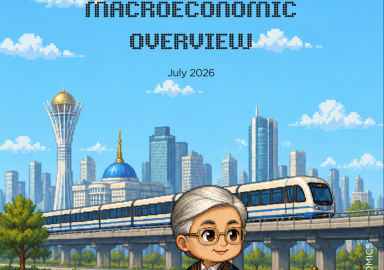
The cover of this issue captures the spirit of the “nova days” – a moment defined by the erosion of the global order’s former stability and a clear shift away from rules-based economics toward power politics and geostrategic rivalry. Economic dynamics are increasingly determined not by market fundamentals, but by confrontation, institutional pressure, and the gradual breakdown of universal rules. This thesis is further reinforced by the news of April 28 that the UAE has decided to exit the OPEC cartel, an institution that has been in place since the 1960s.
According to the IMF, the global economy is developing “in the Shadow of War.” The escalation of direct military confrontation between the U.S. and Iran has transformed a regional conflict into a systemic global risk. The central node of this threat is the Strait of Hormuz, through which roughly one-fifth of global seaborne oil supplies and a significant share of LNG exports pass. Even limited disruptions or threats to navigation in this corridor have already been sufficient to drive up the geopolitical risk premium in energy markets. However, the persistence of ultra-high oil prices above $100/bbl over the medium term remains open to question (see below: Details. The price of closing the corridor: uneven effects).
The baseline forecast of the IMF puts global growth in 2026 at around 3.1% (YoY), conditional on geopolitical tensions remaining contained. The outlook from the WTO is more downbeat. It projects growth of 2.8% if the conflict is resolved swiftly, and just 2.5% should escalation continue.
Commodity markets in 2026 are marked by heightened volatility and a sharp repricing in the energy complex: in March, the energy index surged by more than 40.0% amid geopolitical risks and threats of supply disruptions. Price dynamics in industrial metals remain comparatively subdued, while the fertiliser market is seeing a pronounced upswing -largely on the back of rising nitrogen fertilizer costs. According to the FAO, global food prices have now increased for a second consecutive month, with the Food Price Index reaching 128.5 points in March, up 2.4% (MoM). Taken together, these trends point to a growing dominance of geopolitical factors and elevated price uncertainty, with limited evidence of broad-based, fundamentals-driven growth outside the energy sector.
The output restraint policy of OPEC+ remains geared towards supporting prices. Yet its effectiveness is increasingly diluted by rising production outside the alliance and mounting fiscal pressures on some of its members. As a result, short-term price dynamics are driven less by underlying supply–demand balances and more by the shifting geopolitical backdrop.
Kazakhstan’s economy is evolving against the backdrop of these global developments. Following the acceleration observed last year, growth is expected to moderate in 2026 (the short-term economic indicator reached 2.5% (YoY) in January–March 2026). Inflation remains elevated at 11.0%, sustaining tight monetary conditions. Volatility in commodity markets and the fragmentation of the global economy are increasing the importance of macroeconomic resilience and the quality of economic policy.
AERC has revised down its 2026 growth forecast from 4.85% in January to 4.6% (YoY). The downgrade reflects a combination of factors: an anticipated decline in oil production relative to last year, a slowdown in fixed capital investment, and weaker export growth compared with imports.
A modest easing in aggregate demand growth is expected to support disinflation. As a result, AERC has lowered its average annual inflation forecast from 9.5% (January 2026) to 9.0% for 2026. At the same time, softer demand dynamics have led to a widening of the projected fiscal deficit – from 3.3% to 3.5% of GDP. By contrast, the current account deficit outlook has improved, narrowing from 4.3% to 3.7% of GDP.
Stay up to date with news from AERC