

This article is a review of the study:
Habibullah, M. S., Saari, M. Y., Hamid, B. A., Rahman, M. D. A., & Rosly, N. E. S. C. (2025). Are Holidays Good or Bad for the Economy? A Cross-National Evidence from 101 Countries. Human Security, 31-46.
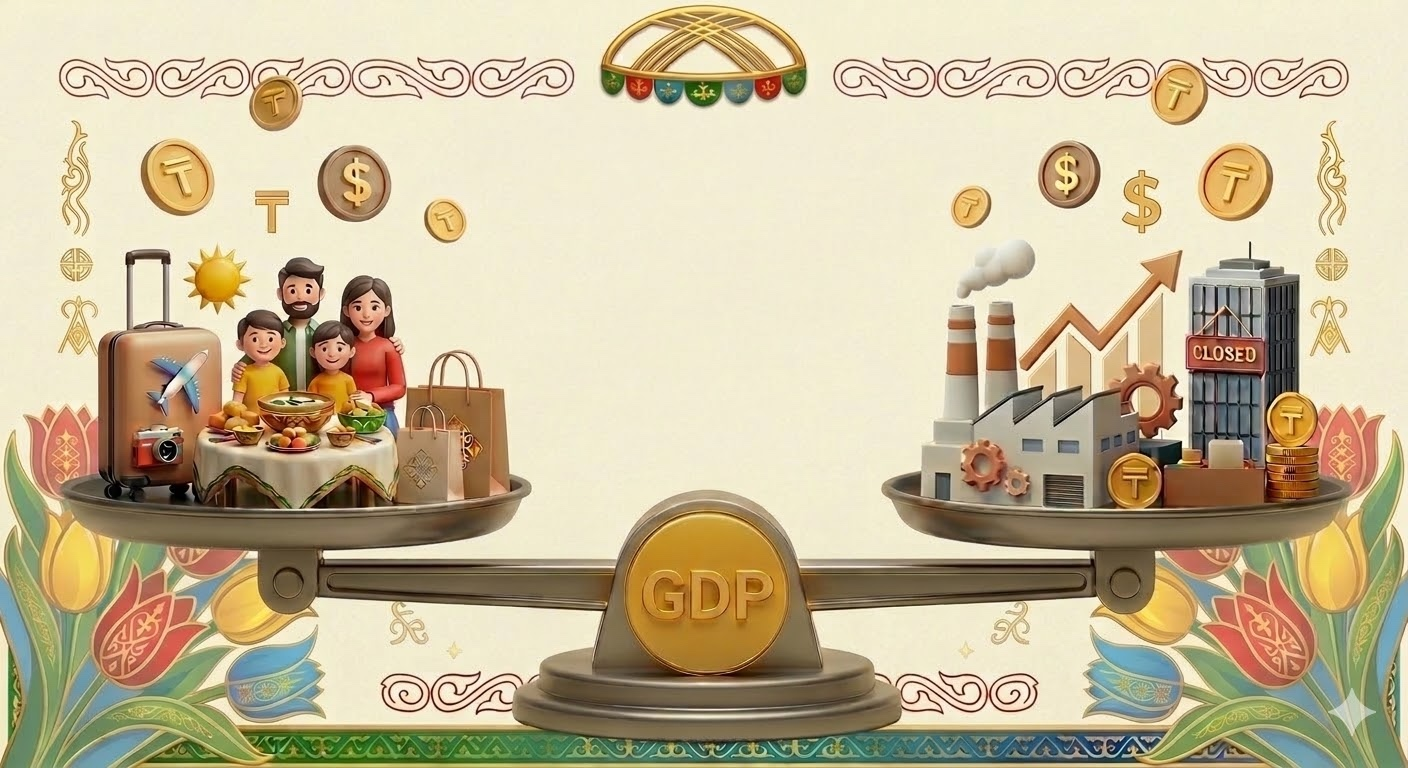
Ahead of the Nauryz celebrations, when Kazakhstanis can expect five days off, the question becomes particularly relevant: how do public holidays affect the economy?
Holidays are traditionally perceived as a time for rest, family gatherings, meeting friends, and attending public events. For economists, the question of how national holidays impact a nation’s welfare remains a subject of debate. In a new study by Habibullah et al. (2025), data from 101 countries were analyzed to determine where the line between “beneficial” rest and economic losses can be drawn.
Existing literature does not provide a clear conclusion on the impact of holidays on economic growth, highlighting its context-dependent nature.
On the one hand, theoretical models suggest that increasing the workforce or working hours should raise production levels. However, empirical studies show that prolonged increases in working time can have negative consequences: fatigue, higher risk of workplace accidents, health deterioration, and reduced social cohesion. At the same time, leisure and public holidays can positively affect the economy through several mechanisms:
However, these effects are not unlimited. Min et al. (2016) note that although leisure-driven tourism initially stimulates growth, its marginal contribution diminishes as countries reach higher levels of economic development. Empirical evidence confirms the non-linear nature of leisure effects. Cui et al. (2019) analyzed data from 21 OECD countries and found that moderate leisure positively affects productivity, while excessive leisure reduces working time and overall output. Similarly, Wang et al. (2022) identified an inverted U-shaped relationship between leisure time and productivity in China’s manufacturing sector: productivity increases with leisure up to 4.7 hours per day, but declines beyond that. This effect is largely explained by improvements in employees’ physical health and subjective well-being. Thus, existing research confirms that the impact of rest and holidays on economic growth is non-linear.
The key finding of the study was the confirmation of a non-linear relationship between the number of holidays and economic growth. The analysis showed that economic growth initially accelerates with an increasing number of holidays, reaches a peak, and then begins to decline.
This pattern is explained by the balance between consumption benefits and the opportunity costs of lost working time. In the early stage, the “consumption effect” dominates, but after the optimum is exceeded, the reduction in productive capacity outweighs the benefits of holiday spending.
Analysis of data from 101 countries using various models revealed:
Quantile regression analysis showed that the optimal number of public holidays varies depending on the level of economic growth:
It is likely that economies with stronger and more sustained growth are better able to absorb the costs associated with additional holidays without compromising overall growth.
In Kazakhstan, the number of public holidays varies from year to year: between 2020 and 2026, it ranges from 13 to 16 days. The main changes are due to religious holidays such as Christmas (January 7) and Kurban Ait (May 27 in 2026), which is determined according to the lunar calendar. Since these days are not moved, when they coincide with weekends, the total number of days off might decrease.
For comparison:
Holidays and days off serve as a significant instrument of economic policy, extending beyond their social or cultural relevance. They are not inherently detrimental to GDP. When properly calibrated, they can be part of a strategy to boost productivity through human capital and stimulate domestic demand.
*This article was prepared using AI tools: NotebookLM and ChatGPT.
Work Calendar for 2026. ConsultantPlus. https://www.consultant.ru/law/ref/calendar/proizvodstvennye/2026/
Kyrgyzstan - Production Calendar for 2026. https://www.calend.ru/work/kirgizstan/
Federal Holidays: 2026. US Office of Personnel Management. https://www.opm.gov/policy-data-oversight/pay-leave/federal-holidays/#url=2026
Legal Holidays: Holidays 2026. Austrian Consulate General. https://www.bmeia.gv.at/en/austrian-consulate-general-new-york/news/legal-holidays
Netherlands Marks 80 Years of Freedom on Liberation Day. (2025, May 5). The Netherlands and Host Nation. https://www.netherlandsandyou.nl/web/nl-host-nation/w/netherlands-marks-80-years-of-freedom-on-liberation-day


