The global economy remains resilient but continues to operate amid considerable geopolitical uncertainty. Key risks include the conflict in the Middle East and related threats to shipping through the Strait of Hormuz, Houthi attacks on commercial vessels, the ongoing war in Ukraine, and rising tensions in global trade. These factors support elevated energy commodity prices, exacerbate inflationary risks, and constrain investment activity. At the same time, the Trump administration is attempting to advance negotiations with Putin, partly easing sanctions pressure to preserve room for dialogue. However, the prospects for a lasting settlement remain uncertain. As a result, the global economy continues to expand, supported by the resilience of the U.S. economy and investment in technology and artificial intelligence. Nevertheless, growth remains below historical norms, while risks to energy markets, trade, and financial stability remain elevated.
In its October World Economic Outlook, the IMF slightly upgraded its forecast for global economic growth in 2026 from 3.0% to 3.1% (YoY), followed by an acceleration to 3.4% (YoY) in 2027. The World Bank has not issued an updated forecast, and its projection for global growth in 2026 remains unchanged at 2.5% (YoY). The difference between these estimates reflects uncertainty surrounding energy markets, geopolitical risks, and the outlook for global trade.
Geopolitical developments continue to be the principal factor shaping prices in commodity markets. Conflicts in the Middle East have significantly increased uncertainty in energy markets and intensified inflationary pressure in many countries. The risk of supply disruptions continues to support oil prices. This creates favorable market conditions for net exporters of hydrocarbons, helping them maintain their fiscal and current account balances.
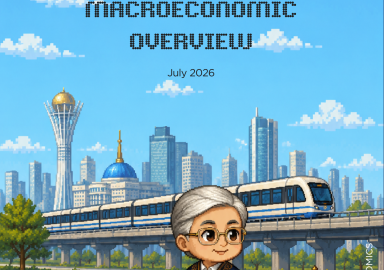
AERC has dedicated the cover of this edition of the Kazakhstan Macroeconomic Overview to the victims of the tragedy in the Caspian Sea in September 2026. The image of a stormy sea and an ominous sky symbolizes the fragility of the established order and the high cost of mistakes amid the growing complexity of contemporary geopolitical and economic challenges. This underscores the importance of responsible risk management, safeguarding strategic infrastructure, and maintaining macroeconomic stability.
Kazakhstan’s economy continues to record strong growth this year. However, there are signs of cooling aggregate demand, as reflected in retail trade figures, the short-term economic indicator, the number of new housing transactions, and corporate income tax and social tax revenues. According to the Government of the RK, economic growth reached 4.2% over the first nine months of 2026, driven by construction, manufacturing, trade, and agriculture. Annual inflation slowed to 9.3% in September, against which backdrop the regulator began gradually lowering the base rate. Rising energy prices are improving export performance and the current account balance, further entrenching the problem of an excessively strong tenge and potentially leading to significant imbalances over the medium term (see below: 'Details. Good to Have a Strong Tenge?').
AERC revised its estimate of economic growth in 2026 from 4.8% (YoY) in July to 4.6% (YoY), based on its aggregate supply and aggregate demand models. On the supply side, the downward revision reflected slower growth in mining and quarrying, manufacturing, transportation and storage, and wholesale and retail trade. On the demand side, the adjustment was driven by changes in estimates of household consumption, gross fixed capital formation, and exports. The outlook for 2027 is more positive: AERC projects GDP growth of 4.7% (YoY) under both its aggregate demand and aggregate supply models. The main growth drivers are expected to be gross fixed capital formation, manufacturing, and construction.
Cooling aggregate demand, combined with tight monetary policy, is expected to help contain inflationary pressures, partially offsetting the upward pressure on domestic prices from fuel price liberalization and reforms in the housing and utilities sector. Accordingly, AERC has slightly revised down its average annual inflation forecast from 10.4% in July to 10.3%. In 2027, AERC expects average annual inflation to decline to 8.9%.
An improvement in the trade balance this year is expected to contribute to a current account surplus of 0.8% of GDP, compared with a deficit of 4.4% of GDP projected in July 2026. In 2027, an expansion in construction activity is expected to increase imports of capital goods, and the current account is projected to record a deficit of 1.7% of GDP.
Despite fiscal consolidation, AERC forecasts a widening of the state budget deficit from 2.3% of GDP, as expected in July 2026, to 3.1% of GDP. In 2027, AERC projects an improvement in the fiscal balance to (-)1.6% of GDP.
Note: The forecasts reflect information and decisions published by the time the calculations were finalised. Additional initiatives first announced in the Address of the President of the Republic of Kazakhstan on 28 October 2026 are not incorporated into the forecasts and may be included in subsequent updates as the details of their implementation are clarified.
Stay up to date with news from AERC